
The radial velocity method
Ground-based radial velocity measurements of candidate planets detected by PLATO will be carried out to confirm or reject the planet…

Ground-based radial velocity measurements of candidate planets detected by PLATO will be carried out to confirm or reject the planet…

Asteroseismology is the study of the intrinsic oscillations (e.g. normal modes) of stars (Aerts et al. 2010). The oscillations generate…

The overall PLATO mission profile consists of the following phases: Pre-launch phase, from launch campaign preparation to launch vehicle…

PLATO is foreseen to be launched in 2026 from Kourou by a Soyuz 2-1b rocket with Fregat upper stage and…
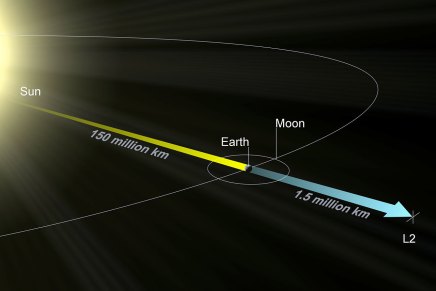
Operational Orbit PLATO will perform its scientific observations on a free-insertion, large amplitude, eclipse-freelibration orbit around L2. This orbit is unstable…
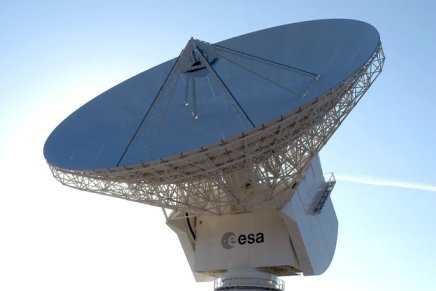
The available data volume transmitted by K- and X-band antenna is 435 Gb average per day. The budget is separated…

Each of the 24 normal and 2 fast cameras includes: the Telescope comprised of the Telescope Optical Unit (N-TOU and…

Planet detection and characterisation R-SCI-L0-01 PLATO shall detect and characterise hundreds of planets around dwarf and subgiant stars of spectral…
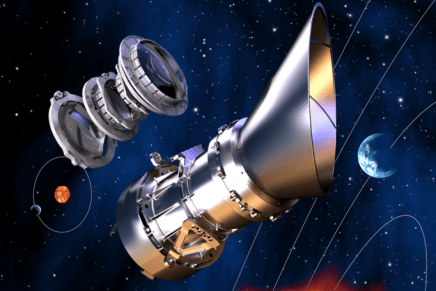
There is no general difference in the TOU design for normal and fast telescopes, but the latter will include filters…

The PLATO spacecraft is a 3-axis stabilised system with a launch mass of 2165 kg, including consumables, and size of…

PLATO has a flexible observing approach. Two observing strategies are reflected in the science requirements, long-duration observation of the same…

For each spacecraft pointing, the list of targets to be observed will be identified and compiled in the PLATO Input…
These requirements provide the specification of the mission capabilities, and are derived from the high-level science requirements. R-SCI-035 The capability…

The baseline telemetry budget yields a daily data volume of 435 Gb. The data products will be reformatted into…

R-SCI-290 The payload shall provide high precision photometric time series in the wavelength band of 500 nm to 1000 nm….
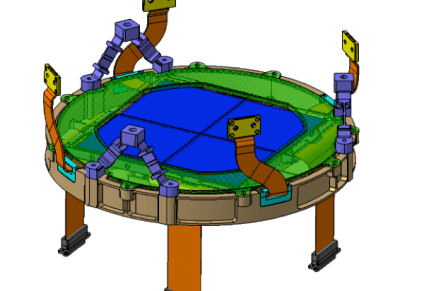
The PLATO detectors are CCDs provided by e2v, model CCD270, specifically developed for this mission. They are built with two…
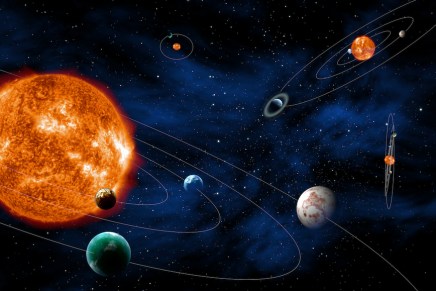
“Gaps” are defined as time during which science observations are suspended while other spacecraft operations are performed. R-SCI-400 During nominal…

The N-FEE operates the 4 CCDs of a normal camera, digitizes the image data and transfers them to the DPU….
Main Electronics Unit (MEU) and Data Processing Units (N-DPU) Each Main Electronics Unit (MEU) gathers in the same box: 6…
Data of the two fast telescopes are processed by two Fast DPUs (F-DPU). The data acquisition and handling of each…
The Ancillary Electronic Units (AEUs) have the following main functions: To supply secondary power to the Front End Electronics (FEE)…

Both ICUs (main and redundant) are located in a single box and work in cold redundancy. Each ICU shall implement…

After identification of a planet candidate, ground-based follow up observations are needed to confirm and characterise the planetary nature of…
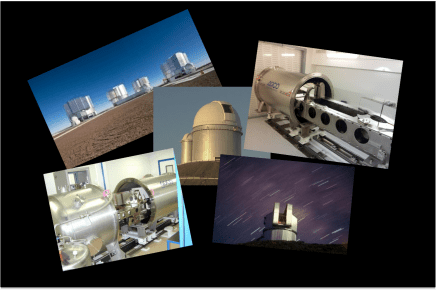
Required telescope time for planet mass determinations From the information on the planet yield, the cost of “equivalent precision” radial…
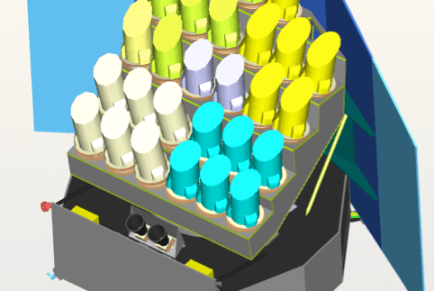
The accommodation of 24 normal + 2 fast cameras and associated electronic units has a mass allocation of 533 kg, with…
PLATO is a transit survey mission with the goal of detecting and providing bulk characterisation for new planets and planetary…

Since the discovery of the first extrasolar planet orbiting a solar type star in 1995 (Mayor & Queloz 1995), just…

A prime goal of PLATO will be to detect a large number of planets, down to the terrestrial regime in…
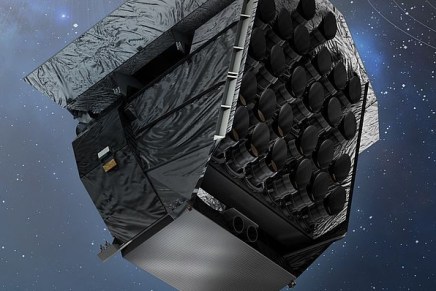
Date: 26 April 2018 Satellite: PLATO Copyright: Artist’s impression © OHB System AG

Automatized alignment of the focal plane assemblies on the PLATO cameras L. Clermont, J. Jacobs, P. Blain, M. Abreu, B….
 platomission.com