
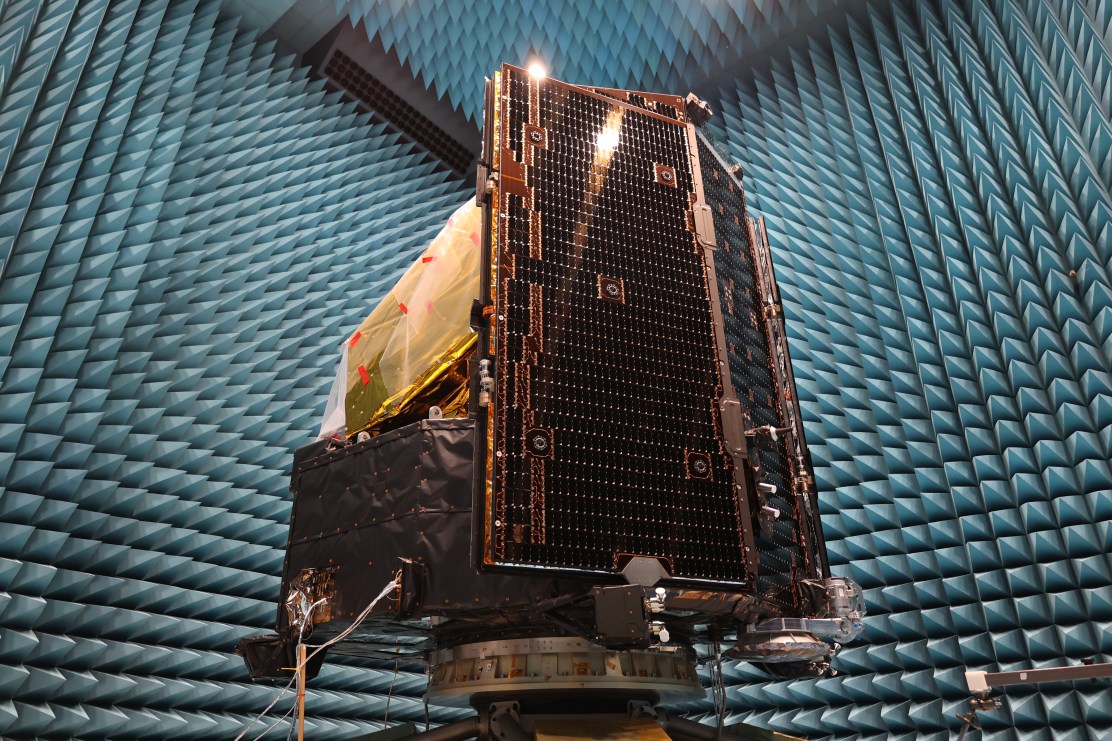
The European Space Agency’s terrestrial planet hunter PLATO has recently completed a series of key tests inside the Maxwell Test Chamber at ESTEC, demonstrating that its electronic equipment is fit to work in space.
This photo captures the spacecraft standing inside the special chamber. The shielded enclosure features conducting metal walls, floor, and ceiling that form a Faraday cage, screening out all external interference. Its 9 m-high interior is lined floor to ceiling with foam spikes that absorb electrical signals and sounds to mimic the void of space.
Once the chamber was sealed closed, engineers remotely switched on and commanded Plato’s electronic equipment. They ran a series of tests to ensure that the spacecraft’s complex instruments and modules did not interfere with each other or with the communication systems, creating unwanted ‘crosstalk’.
In the extreme vacuum of space, a spacecraft’s electronics can behave differently than they do in a typical test lab on the ground. Without proper testing, this can have unforeseen consequences that could affect the mission’s goals or even damage the equipment.

Thanks to the tests run in the Maxwell Test Chamber, engineers verified that Plato’s many electronic systems can work together in space without interference – in other words, that they are electromagnetically compatible.
With compatibility checked off, PLATO has now cleared the last remaining major exam in the series that the spacecraft must undertake to graduate for launch.
The exams started back in January this year with vibration and acoustic tests, followed by a month-long stay inside the Large Space Simulator where Plato aced a demanding set of tests and demonstrated that it is fit to withstand the harsh conditions of space.
Credits: ESA / R. Moorkens O’Reilly


