
The European Space Agency’s mission to discover Earth-like exoplanets, Plato, is currently sealed in the Large Space Simulator (LSS) chamber at ESA’s Test Centre for a series of vital tests under space‑like conditions.
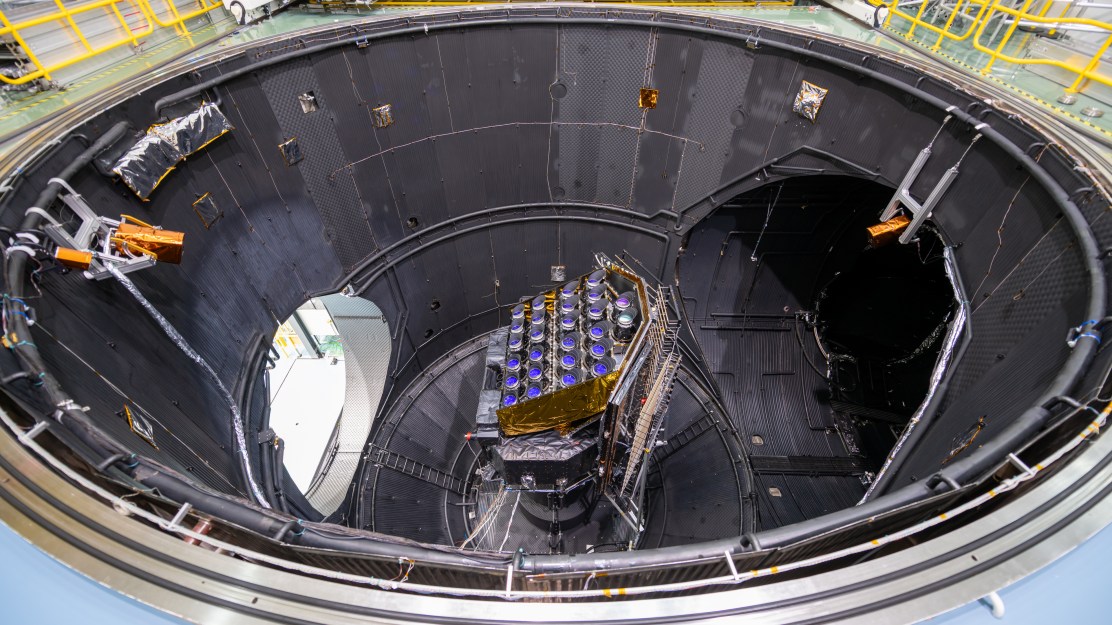
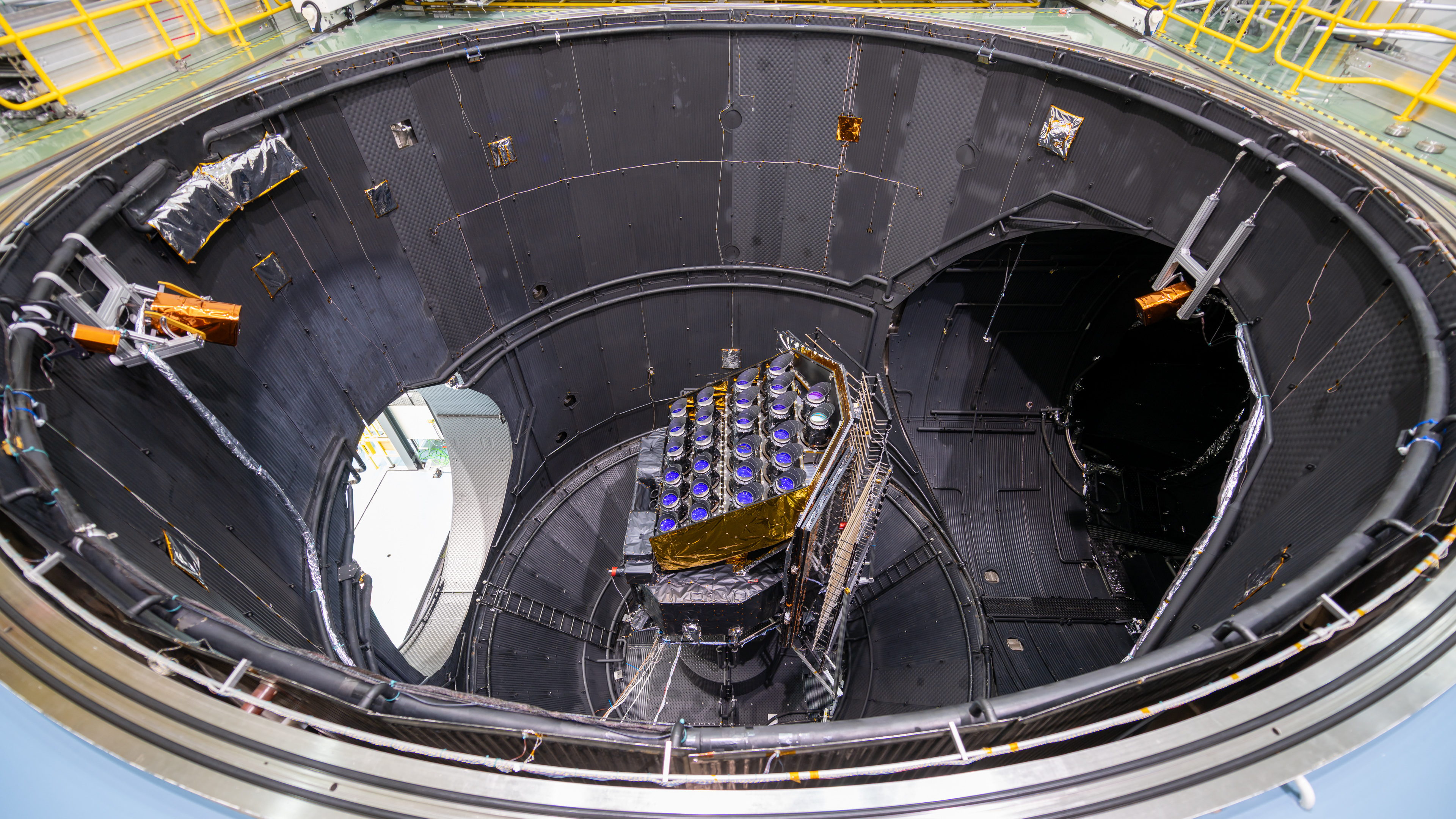
Engineers placed Plato in the LSS on 18 February, and since beginning of March the spacecraft has been experiencing the extreme temperatures and vacuum of space. This photo captures the satellite standing in the centre of the simulator, moments before the door of the chamber was hermetically closed.
The picture was taken from the top opening of the LSS and gives us a direct view of Plato’s 26 ultrasensitive cameras. These are the special eyes that the mission will use to monitor more than 150 000 bright stars at the same time, hunting for terrestrial planets orbiting Sun-like stars.
The mission is expected to be ready for launch by the end of the year. Lift-off on an Ariane 6 is planned by Arianespace for January 2027.
But before launching a spacecraft, it is crucial to operate it and check all its functionalities in a space-like environment. The LSS offers just that.
A cylindrical container standing 15 m high and 10 m wide, the LSS is Europe’s largest cryovacuum chamber. Equipped with a high-performance pump, the enclosure achieves a pressure a billion times lower than the sea-level atmosphere, while liquid nitrogen circulating around its casing reproduces the cryogenic temperatures of space.
Exposed to a grid of powerful heating elements (so-called ‘calrods’) that simulate the heat of the Sun, the spacecraft’s backside – with solar panels and sunshield – reaches a toasty 160°C. At the same time, thanks to the sunshield and excellent insulation, the cameras and the optical bench facing the dark, cold part of the chamber are kept very cool at around –80°C, as if facing deep space.
Plato will reemerge from the space simulator at the end of March.
(link to original press release)
Credits: ESA – European Space Agency
 platomission.com
